
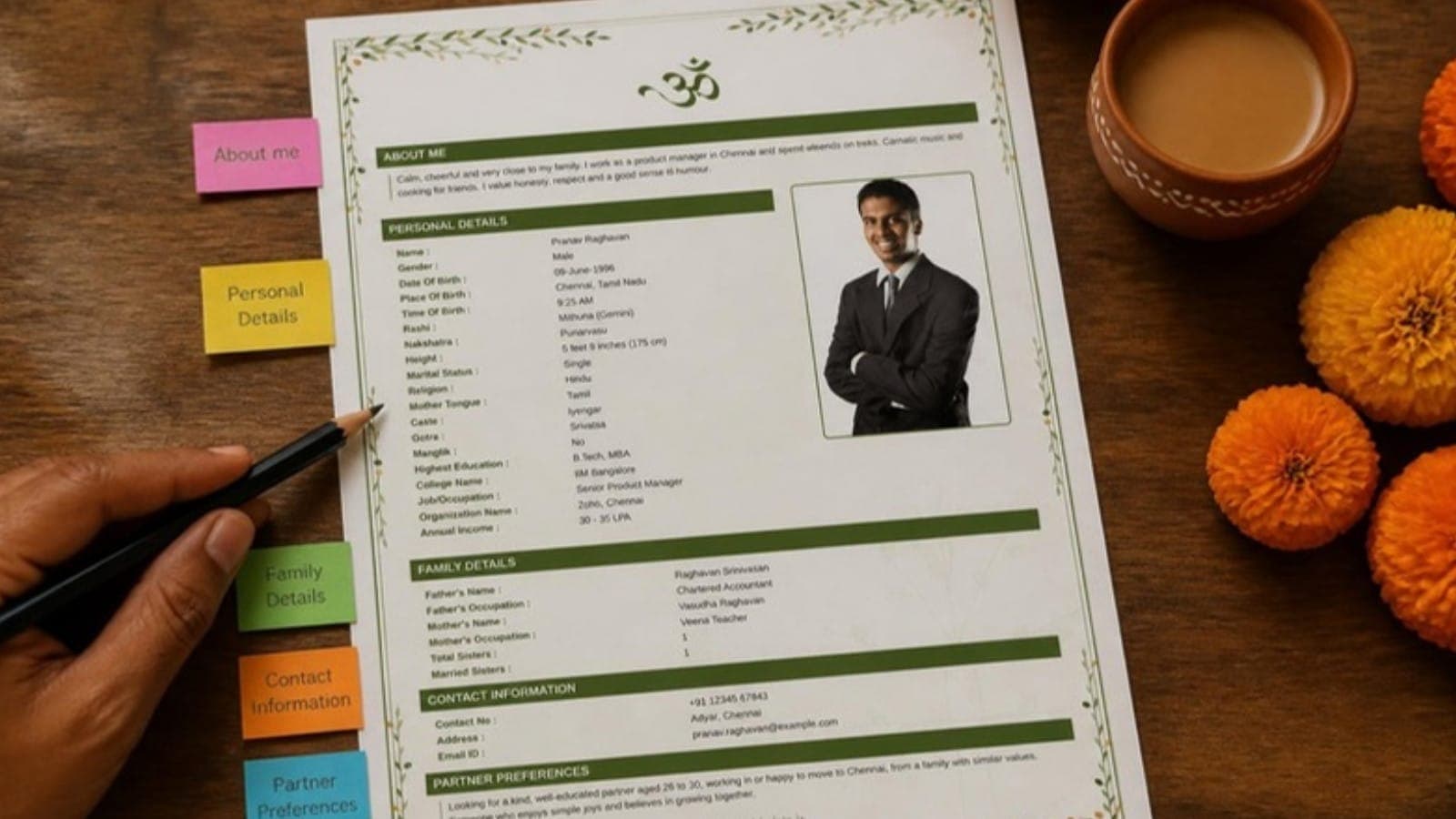
Search for how to write a biodata for marriage and you mostly get a list of headings. Headings are the easy part. The hard part is knowing what to actually write under each one, and how much. So instead of another list, this guide takes one complete sample biodata and walks through it from top to bottom: what each part says, why it is there, and how to write your own.
Table of Contents
The Sample Biodata We Will Walk Through
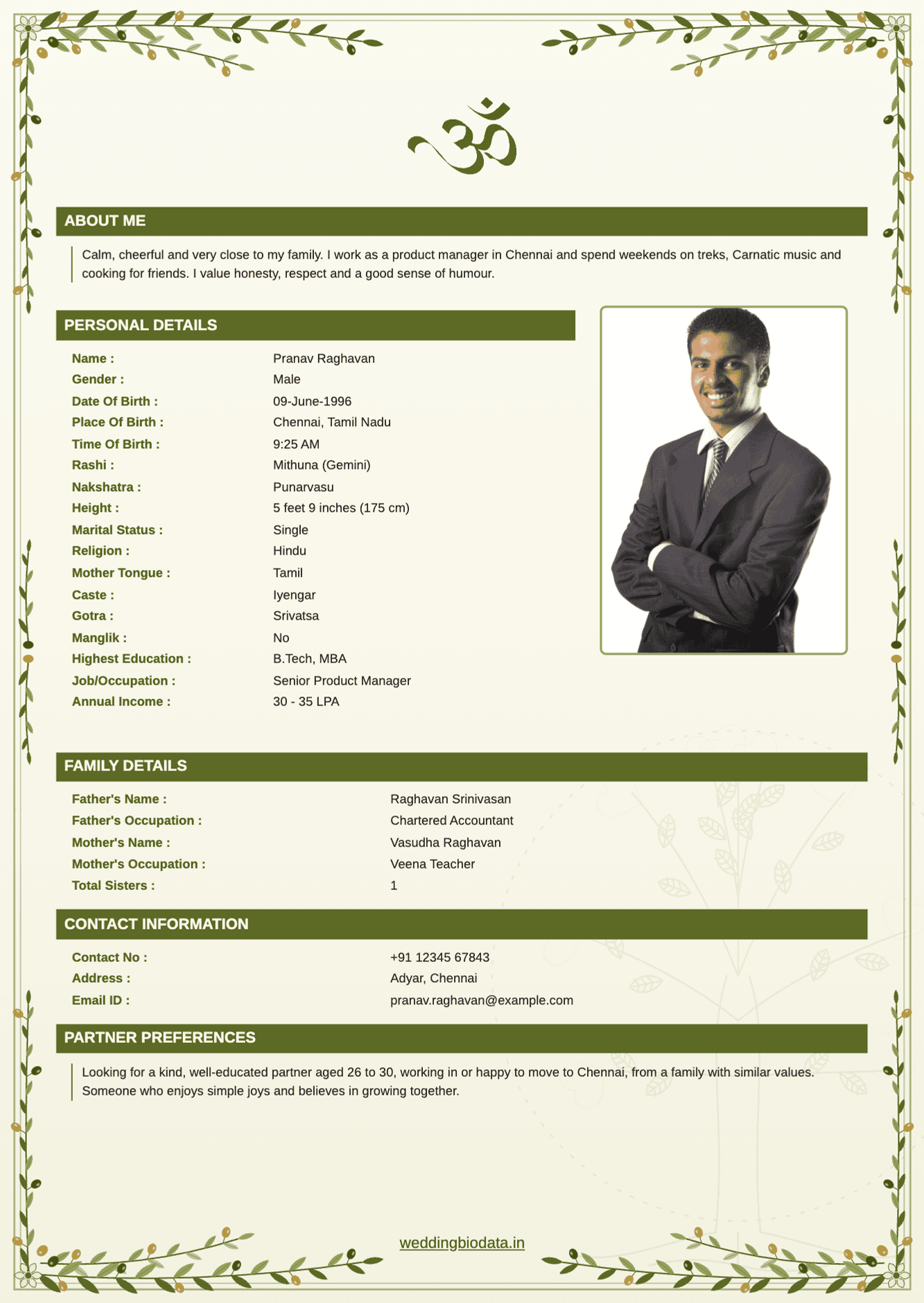
Here is the example: a one-page biodata for Pranav, a 30-year-old product manager from Chennai, made with our free biodata maker. It follows the order most families expect: a blessing at the top, a short About Me, the photo beside personal details, then family, contact and partner preferences at the end.
Keep it open as you read. Every section below points back to a part of this page.
The Top: A Blessing or a Simple Heading
Families often look at the top of the page first, before they read a single detail. Most biodatas open with a religious symbol, such as Ganesh or Om, the Khanda, a cross or a crescent and star, or with a decorative “Biodata” heading if you prefer something neutral.
Choose one, keep it small and centred, and do not add a second. In Pranav's biodata it is a single Om, which tells a Hindu family what kind of biodata this is before they read a word.
About Me: Three Lines in Your Own Voice
This is the only part of a biodata that sounds like a person rather than a form, so it is worth writing well. A simple formula works for almost everyone:
Pranav's version: “Calm, cheerful and very close to my family. I work as a product manager in Chennai and spend weekends on treks, Carnatic music and cooking for friends. I value honesty, respect and a good sense of humour.”
Keep it to two or three lines, avoid clichés like “simple and down to earth” unless you add something specific, and never copy a stranger's paragraph. More examples are in our guide to the About Me section.
The Photo: Recent, Clear and Well Framed
The photo sits beside your personal details, so it is the first thing anyone remembers. Use a photo taken in the last few months, facing the camera, in good light, with a plain background and clothes you would wear to meet the family.
Crop it to a portrait shape so your face is not squashed or cut off. Our maker crops it to fit the biodata for you. For sizes and common mistakes, see the biodata photo guide.
Personal Details: The Facts Families Check First
Write these as short facts, not sentences. A good order is:
Only write what is true and what you are comfortable sharing with strangers. If you are unsure whether a field belongs, our guide on what to include in a biodata covers each one.
Family Details: Enough to Picture Them
Families want a picture of the household, not a family tree. Give your parents' names and occupations, then brothers and sisters, with whether they are married if that matters in your community.
Pranav lists his father (a chartered accountant), his mother (a veena teacher) and one married sister. Five lines, and the reader already has a sense of the home. Extended relatives, property and family history can wait for a conversation.
Contact: One Number That Will Be Answered
Give one contact number that someone will actually pick up, usually a parent's or your own, an email, and your city or area rather than a full home address. If an elder handles enquiries, put their number first and say whose it is.
Double-check this line before you share the biodata. A single wrong digit means interested families simply cannot reach you.
Partner Preferences: Specific, but Not a Checklist
This optional last section says what you are looking for. The best ones are specific enough to be useful but open enough to stay warm. Cover a few of these:
Pranav's version: “Looking for a kind, well-educated partner aged 26 to 30, working in or happy to move to Chennai, from a family with similar values. Someone who enjoys simple joys and believes in growing together.”
Avoid long lists of demands, comments on looks or skin colour, and anything you would not say to a family in person.
How Long Should a Marriage Biodata Be?
One page is ideal and two is the most anyone will read. If yours runs longer, shorten the About Me, drop optional fields, or use a smaller text size rather than squeezing the margins.
Before you share it:
Conclusion
A good marriage biodata is short, honest and in a sensible order: a blessing, a few lines about you, your photo and personal details, your family, a way to reach you and what you hope to find. Use Pranav's sample as a model, write each part in your own words, and our free biodata maker will lay it out on a beautiful one-page design for you.
Ready to Create Your Perfect Biodata?
Use our free online biodata maker to create a beautiful, professional marriage biodata in PDF format - no design skills needed!
Create Your Biodata Now